Review: Black Swan (2010)

Darren Aronofsky’s psychological thriller is a twisted adaptation of the famous ballet Swan Lake that blurs the boundaries between high art and exploitation film.

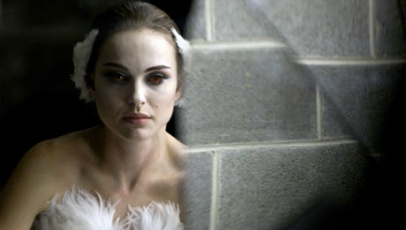
Nina Sayers (Natalie Portman) is consumed by her obsession of being the perfect ballerina. When Nina learns that the principal ballerina, Beth (Winona Ryder), is being let go at the end of the season, she sees an open door that could lead to hear dreams coming true. But the arrival of Lily (Mila Kunis), a naturally talented and laid-back ballerina, brings her self-esteem issues to the forefront.

Nina wins the role of the Swan Queen in the company’s production of Swan Lake, and it soon begins to take its toll on Nina as practices become more grueling and the company’s director, Thomas (Vincent Cassel), plays mind games with her.As her life is ever more consumed by ballet, she begins to get more in touch with her dark side – a recklessness that threatens to destroy her.

Black Swan highlights the savageness of performance and the innumerable issues that come from an aspiration for perfection. Nina is a newcomer, her problems are all related to the inherent worry of making an affecting first impression and bettering her counterparts. The thematic elements used work together to make Black Swan feel like vital, candid and ultimately contemporary tale; almost like a culmination of the director’s masterfully distinctive filmmaking style that’s developed over the past twelve years.

Matthew Libatique’s evasive and intense cinematography beautifully captures Nina’s fracturing mental state, her delusions and perpetual anxieties, masterfully blending reality and illusion. The claustrophobia of Nina’s shattered mind is superbly transposed to the sheer, heart-pounding ebullience of the stage, capturing in detail every affliction Nina suffers in her bid for perfection, while equivalently showcasing ballet as a undeniably majestic art form.

Clint Mansell’s take on Tchaikovsky’s famous score is tremendous. Not only does the music stay true to the heart of Swan Lake, but it and adds new themes, motifs and emotions; complimenting, and enhancing, the film’s sinister nature magnificently.

Portman is truly exquisite as Nina, embodying the character of a young woman paralysed by her torturous desire for perfection desperately trying maintain a grip on her sanity faultlessly. We witness Nina simultaneously at her most exposed and her most barbaric, reaching her zenith with a sharp, enticing career-defining dance, much like Portman’s career-best performance.

The supporting performances are equally strong: Cassel wonderfully sordid as the company’s director; Kunis remarkably piercing and intoxicating as Lily; Hershey as Nina’s overpowering mother, Erica; and Ryder making the most of her limited screen-time as Beth, embracing the film’s demented nature and enveloping the mania of her cutthroat character.

Black Swan is thoroughly captivating, wonderfully shredding the human soul down to the bone and forces the audience into Nina’s disintegrating mind. The depth of the film builds up to a compelling, fantastical and veracious crescendo, the final performance, which works equally as a fitting conclusion, and as an astonishing validation of the ruthless art of perfection.

In simple terms, it’s an utterly tremendous cinematic masterpiece.
Review: Conviction (2010)

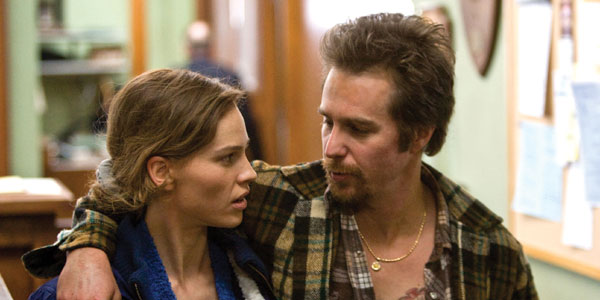
Based on a true story, Conviction tells the story of a working mother, Betty Ann Waters (Hilary Swank), who puts herself through law school in an effort to represent her brother, Kenny Waters (Sam Rockwell), who has been wrongfully convicted of murder and has exhausted his chances to appeal his conviction through public defenders.

Tony Goldwyn’s direction, while pleasing and sometimes well dramatised, often feels awkward, tiresome and disengaging, struggling to bring out the emotion and capture the inspirational message in an engaging manner, mainly due to the haphazard execution of the films structure, which mostly eradicates the possibility of emotional investment.

It would be easy, therefore, to cast off Conviction as a TV film trying, yet failing, to be something more, but that would be an injustice to the fantastic performances on show from more or less every actor involved..

Hilary Swank delivers a typically veracious, if less than stellar, turn as Betty Anne, while Sam Rockwell inhabits the role of Kenny with an extraordinary level of depth and naturalism, unavoidably making you trust him and believe his innocence.

Minnie Driver injects much-needed humour and likeability into the film as swank’s loyal compadre, and Juliette Lewis, despite only appearing in two scenes, completely envelops her character, giving a breathtaking performance as a wasted tramp whose also a key witness for the prosecution.

Conviction is ultimately an okay, yet disappointedly constructed, tale of retribution, elevated by several terrific performances.

Review: Thank You For Smoking (2005)

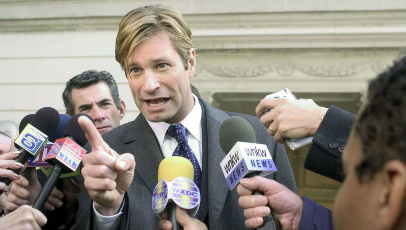
Thank You For Smoking is based on  the 1994 novel of the same name by Christopher Buckley. It follows the schemes of Big Tobacco’s chief spokesman, Nick Naylor (Aaron Eckhart), who twists the truth on behalf of cigarettes while trying to remain a role model for his twelve-year-old son, Joey (Cameron Bright).

It is, essentially, a clever, humorous and effervescent satirical comedy. Plainly it provides a host of fascinating truths about the tobacco dispute – some of them true, some of them false – sugar-coating and simplifying them to appeal to our emotions. Jason Reitman’s direction is rapid, enlightened, and irrefutable; his writing overflowing with ripe, razor-sharp dialogue, one-liners and tantalising characters.

Eckhart is simply outstanding as Nick, the Vice President of the Academy of Tobacco Studies, an organisation that studies the effects of smoking on the nation’s health. He plays the character with an almost effortless level of charm and incredible versatility, delivering Nick’s lines with an arrogant, yet loveable nature. In one scene we’ll be admiring his candidness and, in the next, we’ll accept him as the devoted father-figure.

The structure, at times, seems a little dismayed, and the investigation into the tobacco industry feels somewhat rudimentary, but these are minor issues, ones that only slightly detract from the overall enjoyment. That said, Eckhart and the entire supporting cast – in particular J.K Simmons, who delivers his lines like he’s only vaguely grasped their meaning and accuracy – each deliver equally measured, good-humoured performances, bringing an astounding sense of believability to their respective characters and, in turn, the whole film.

Thank You For Not Smoking, trivial flaws aside, is an assured, witty and intelligent debut from writer-director Jason Reitman, with an exuberant, stand-out performance from Eckhart.

Review: Brilliantlove (2010)

Originally titled The Orgasm Diaries, Brilliantlove is an indie sex drama about the steamy relationship of amateur photographer, Manchester (Liam Browne), and a young taxidermist, Noon (Nancy Trotter Landry).

When a successful dealer, Franny (Michael Hodgson), discovers Manchester’s portfolio, he thrusts his work onto the art world. Manchester’s consequential success destroys the beauty of the couples once idyllic romance.

Brilliantlove starts off as an explicit, atmospheric and titillating art parody, presenting Manchester and Noon either having sex or blatantly thinking about doing it. demonstrating a realistic environment in which the pure expression of love overcomes everyday concerns.

Ashley Horner’s simplistic and naturalistic direction perfectly illustrates the sexual, enchanting environment Manchester and Noon have concocted, in which the pure expression of love – particularly sexual desire and fornication – vanquishes everyday worries.

The two leads – Manchester and Noon – are well portrayed by Browne and Landry, bringing a likeability and naturalistic aura to the film, particularly in the non-sex scenes where they are able to explore their individual personalities and illicit relationship.

The problem comes in the second half when the film, scripted by Sean Conway, tries to explore deeper thematic possibilities, in this case the plot concerning Franny’s exploitation of Noon’s beauty. This breaks the realism that has been carefully constructed, damaging the initially strong premise.

Instead of building upon the premise, and maintaining its illusive charm, the film and its characters struggles outside the comfortabilty of the couples enclosed environment, unfortunately forcing the film to conclude in a predictably drab and unconvincing fashion.

Brilliantlove is an alluring, ethereal and tastefully directed, yet clumsily developed, study into sex, relationships and the irony of art.

Review: The Brothers Bloom (2008)

The Brothers Bloom – Rian Johnson’s follow-up to the critically-acclaimed Brick – is a conceitedly intricate tale of con-men, retribution and love.

The film centers on two con men brothers – Stephen (Mark Ruffalo), the mastermind, and Bloom (Adrien Brody), the so-called anti-hero – who, with the help of their associate explosives expert Bang Bang (Rinko Kikuchi), embark on one last con: tricking a rich, socially-isolated New Jersey heiress named Penelope Stamp

Johnson’s film is a subtly mischievous piece of cinema, cleverly written and whimsical, with a healthy dose of the inanity that made Brick the breakout success it was.

Each of the four leads – Brody, Ruffalo, Weisz and Kikuchi – inhabit their respective roles with a fantastically rich mania, delivering their one liners with incredible, soulful comedic timing.

It’s this, along with the light-hearted, distinguished approach to the direction that brings the warmhearted, densely written script and devilishly intrinsic tone to a exuberant life.

While it may not be as boundary-breaking as Brick, The Brothers Bloom is ultimately a joyous game between Johnson and the audience, one that takes you on an incredible journey, twist after twist, holding your attention, making you laugh throughout.

All in all, it’s a cleverly made, intelligent and high quality film that rewards your investment.

Review: Welcome To The Rileys (2010)

Welcome To The Rileys is a promising debut feature from music video director Jake Scott about tossed souls learning to overcome sorrow and loss.

The film follows Doug Riley (James Gandolfini), a damaged plumbing-supply salesman who struggles to find his place in the world after the death of his daughter, Emily. Things start to look up for Doug when he goes to New Orleans for a conference and meets an underage stripper named Mallory (Kristen Stewart). When Doug tells his wife, Lois (Melissa Leo), he’s not coming home, her response triggers a change for all three characters.

Essentially the film is made up of two parts: the first is the odd, father-daughter relationship between Doug and Malorey; and the second centers on Lois as she is forced to overcome her agoraphobia to save her marriage. When the two worlds are brought together, there’s an initial reluctance from all side, beautifully played by each actor, before they slowly begin to accept each others flaws and mould together.

The narrative is driven by the quieter, intimate moments shared between the characters, rather than relying on brash, noisy confrontations to propel events forward. This technique makes the film more realistic and raw, allowing audiences to understand the characters’ pain and disparity, but also, mainly towards the end, makes the film feel too bitter-sweet, like it’s trying to hard to wrap things up in a neat, content bow.

Gandolfini plays Doug as a benevolent, caring father-figure to Malorey and honest, earnest husband to Lois. Leo is exceptional as the troubled, lost soul Lois, who is pushed to reclaim her life and sense of being through events out of her reach. Stewart brings a naked vulnerability to her performances as Malorey, crafting her into a realistic and vibrant character, haunted by her loneliness and troubled upbringing.

Welcome To The Rileys is a solid debut piece of filmmaking from Jake Scott, driven by its honest script and three brave and charismatic performances.

Review: Blue Valentine (2010)

Derek Cianfrance directs Blue Valentine, an exacting, achingly distressing look at the complexity of a marriage and its steady dissolve.

The narrative unfolds in a non-linear fashion over two timelines as it tracks the burgeoning romance between Dean (Gosling) and Cindy (Williams), and its eventual breakdown.

The action flicks back and forth, transposing the bright optimism of their young romance – each yearning for one another’s veracity – against the buried anguish and turmoil the dissolve has lead to.

Gosling’s Dean, through flashbacks, is seen as a charming, caring guy, while Williams’ Cindy is an intelligent, wholesome girl attracted to Dean’s fun-loving nature – beautifully captured in a scene where Dean’s playing a ukulele as Cindy dances along.

Their personalities age with the turbulent marriage, Gosling undercuts his characters’ charm with a frightening anger and eruptiveness. Williams’ contained performance as the older Cindy exudes despair and hopelessness, surmising her feelings towards her changed husband.

Cianfrance beautifully transposes the two different time periods with pitch-perfect direction. He uses penetrating camera angles and subdued lighting to represent the turmoil the relationship has become, while intercutting this with bright, snappy flashbacks to convey the puppy-love beginnings.

The film is a deeply visceral experience, pulling you from one emotion to another as it skips so dramatically from the giddy hopes of young love to the painful sorrow of this union’s death throes.

Grizzly Bear’s stripped back tracks are used to great avail as the films core soundtrack, further adding to the emotional integrity this film boasts.

Equally, in the scene where Dean sing’s “You Always Hurt the Ones You Love” and Cindy dances along, the emotional devastation set to behold the troubled pair is hinted as subtly, yet devastatingly so.

Blue Valentine is an emotionally affecting, raw and impeccably acted portrait of a doomed marriage, making brilliant use of the complex, non-linear narrative structure, gaining complete control over the audiences emotions from start to finish.

A breathtakingly real piece of filmmaking from a talented up-and-coming director.

Review: Half Nelson (2006)

Directed by writer-director team Anna Boden and Ryan Fleck, Half Nelson centers on an inter-city high school teacher (Gosling) with a drug habit who forms an unlikely bond with one of his students (Epps).

Boden and Fleck’s direction is impressive, managing to capture the action in an unsentimental and raw manner that’s brimming with humanity and emotional depth.

The relationship between Dan and Drey is pushed to the forefront as both find common-ground with each other through the problems they harbor as they battle to reach their own personal resolutions.

Through the awkward and bleak tone of the film humour erupts naturally, breaking the tension and enabling the audience to emote with and relate to the characters’ problems and hard-hitting themes of addiction, loneliness and acceptance that are explored through the films hard-hitting premise.

Gosling gives a stunning and mesmerising performance as the drug addict teacher, distinguishing this film from others of its nature and warranting his much-deserved Academy Award nomination.

Half Nelson is a well-balanced, brilliantly acted and refreshingly humorous study into the rarity of second chances.

Review: It’s Kind Of A Funny Story (2010)

Based on a teen novel by author Ned Vizzini, It’s Kind Of A Funny Story is a new comedy-drama from the hotly-tipped writer-director team Anna Boden and Ryan Fleck (Half Nelson).

The film centers on a clinically depressed teenager, Craig (Keir Gilchrist), who gets a new start when he checks himself into an adult psychiatric ward after contemplating suicide.

It’s Kind Of A Funny story marks the first time Boden and Fleck have not worked from their own material and the lack of character development and authenticity of the plot is noticeable from the offset.

It’s a light comedy that, although managing to avoid common cliches of the genre, ultimately feels too simplistic, cherry-topping the severity of mental health issues, making them somewhat feel implausible and negligible.

A common trait of this is whenever characters’ health issues are touched upon the direction of the film suddenly switches, as if the writers are sidestepping the underlying complexity of the films premise, instead focusing on the unconvincing relationships between the central characters.

Boden and Fleck can’t be blamed for the writing, but their handling of the material often feels dull and laborious, something that makes the film ultimately monotonous a waste to its audience. It almost seems as though they’ve regressed after the sublime, authentic Half Nelson.

The cast, on the other hand – lead by Gilchrist, Emma Roberts and Zach Galifianakis – boast likeable, dynamic and intermittently convincing performances with the material they have. It’s just a shame they’re let down by an incoherent script, detached direction and inconceivably unbelievable character relations.

It’s Kind Of A Funny Story is an agonisingly bland, contradictory and unoriginal film. The only glimmer of hope for Boden and Fleck’s future comes from the respectable performances and Broken Social Scene’s breezy, equivocal soundtrack.

Review: Winter’s Bone (2010)

Winter’s Bone is a vivid adaptation Daniel Woodrell’s crime novel set in the heart of the Ozark Mountains, Missouri.

17 year-old Ree Dolly (Jennifer Lawrence) is responsible for keeping her family together in a dirt poor rural area. When the local Sheriff (Garret Dillahunt) tells her that her father put up their house as collateral for his bail, Ree sets off to find her errant father, digging up some very dangerous secrets in the process.

Debra Granik brings this bleak environment to life through her flawless attention-to-detail, her keen eye capturing the landscape’s undertones beautifully. Granik tells the story as naturalistic drama, punctuating thrills throughout to keep them authentic and unexpected.

The most obvious example of this is through the character of Teardrop, Ree’s uncle, whom she asks for help. John Hawkes’ performance as Teardrop is haunting, verging on sadistic as it’s never made clear to Ree, or to the audience, whether he will help Ree, assault her, or kill her.

Lawrence’s performance as Ree is a truly stand-out piece of acting, transposing her apparent emotional intelligence and warmth with the incredible pressure she’s under to keep her family alive.

Winter’s Bone is a realistic, engaging and fearless film about transgression and the consequences of digging into the past, showcasing a truly magnificent, afflicting performance from Jennifer Lawrence.