Review: The Switch (2010)

Originally titled The Baster, The Switch is an indie romantic-drama from the mind of Allan Loeb, who previously wrote screenplay’s for Things We Lost in the Fire and 21, and is loosely based on a short story by Jeffrey Eugenides.

The film centers on the overly anxious, perplexing and irritating Wally, who’s unmarried 40-year-old best friend, Kassie (Aniston), turns to a turkey baster in order to become pregnant. After moving to Michigan to raise her child, Kassie returns and reunites with Wally, who has been living with a secret: he replaced her preferred sperm sample with his own.

The Switch, which most would label as a female-centred rom-com, instead switches the focus onto the male’s point-of-view. It ponders serious, life-changing questions about pregnancy and fatherhood, in a heartfelt and humorous way. Bateman plays the role of Wally perfectly, highlighting his charming, wry personality in an endearing and well-natured way, showing Bateman has what it takes to carry a high-profile comedy film.

Aniston, in a much-welcomed departure from her previous films, holds her own, providing an appealing, yet restrained performance as a single mother, letting audiences see why she was Hollywood’s sweetheart in the first place. Jeff Goldbum and Juliette Lewis shine in their limited roles, each embodying their characters to the best of their ability, while never outshining the central leads.

Despite the source material being predictable, and the sometimes cringeworthy dialogue, the directors – Will Speck and Josh Gordon – manage to keep the film on track, heading toward an ultimate goal, maintaining the message throughout and never letting the films throwaway moments overshadow the light-hearted, rather brilliant ones that some critics seem to be ignoring.

The Switch may not break any boundaries, or attract a particularly wide audience, but it’s surprisingly funny and sufficiently light-hearted take on an often bland genre. Bateman proves himself as a male lead, while Aniston proves there’s more to her acting range than silly, generic comedies.


Review: Salt (2010)

With the end of Bourne, and the Bond series on hold due to MGM’s financial difficulties, cinema-goers and studios are looking desperately for the next big spy franchise. It’s of no surprise, then, that Sony have been plugging the release of Salt for a good few months now, stirring up mystery with the ‘Who Is Salt?’ banners that have been circling the internet and plastered over the walls of your local multiplex.

Directed by Phillip Noyce, Salt centres on Evelyn Salt (Angelina Jolie), a seemingly normal undercover C.I.A agent – one that managed to keep her identity secret even when being tortured by North Koreans – married to a German, who doesn’t know her true occupation. Evelyn, when interrogated a Russian named Orlav (Daniel Olbrychski), is labelled as a secret double agent, much to her, and her colleagues’, surprise. Salt then spends the remainder of the film on the run from her boss (Liev Schreiber) and almost every cop in the United States of America, including ONCIX agent Peabody (Chiwetel Ejiofor), who seems determined to finish her.

Despite mirroring the premise of Bourne, or certain Bond films, Salt avoids overstuffing the film with dialogue, instead opting to notch the action up another level, ensuring audiences remain engaged throughout the films running time. Noyce, a relative newbie to the genre, crafts an intriguing, suspenseful and fast-paced spy-thriller, never lingering too long on sub-plots or secondary characters.

Kurt Wimmer’s screenplay is relatively flawless. It’s nimbleness keeps the audience guessing as to who’s the good guy, who’s the bad guy, who works for who, who knows what and, overall, how the film will conclude. The only weakness would be the rather pointless opening and closing sequences, both hindering the enjoyment of the film as a whole. The script keeps the action tight, never lingering too long on sub-plots or secondary characters.

Casting Jolie as Evelyn really was a triumph. Having dabbled in action films before, Jolie uses what she learned on Wanted and Mr. & Mrs. Smith, while upping the testosterone gage and displaying a whole new level of versatility in terms of what she can do as an actress. Salt offers Jolie a new platform, the potential to kick-ass in a franchise of her own. The supporting cast, most notably Schreiber, Ejiofor and Olbrychski, do their best with their limited screen time, but never really breaking out of their comfort zones.

Nevertheless, Salt is solid, fast-paced action-thriller, showcasing Jolie’s raw versatility as an actress. Noyce has a talent for crafting tension, managing to avoid common cliches, whilst keeping audiences engaged. A sequel is inevitable, which is no bad thing in my eyes.

Review: Inception (2010)

Inception is the latest film from movie mastermind Christopher Nolan. After directing such acclaimed and commercially successful films as Memento, The Dark Knight and The Prestige, Nolan returns to cinema screens with another mind-bending summer blockbuster, this time putting the emphasis on dreams, allowing his action to take place across several layers, or levels as they’re referred to in the film.

Centering on Dom (DiCaprio), a superior “extrator” who’s hired by a businessman, Saito (Watanbe) to carry out an “inception”, which is to plant an idea, that will cause Robert (Murphy) to collapse his fathers (Postlethwaite) company following his death.

For around the first hour of the film we’re introduced to Dom and his efforts to assemble a team to accompany him, which eventually include Arthur (Levitt), Eames (Hardy), Yusef (Rao), and Ariadne (Page) who’s hired by Dom to design the dream they’ll be entering to carry out the “inception”.

Dom’s late wife, Mal (Cotillard), who we’re introduced to early on in the film, flits between the dreams, haunting Dom’s mind as a “projection”. Eventually, we learn the backbone to their story, how she died, and why Dom won’t let her go. Although Cotillard doesn’t have much screentime, she brings a mysterious, almost dreamy quality to Mal’s nature, allowing viewers to understand her position within the narrative.

It’s when we enter the first level that the action really gets going and Nolan’s imagination comes to life. Playing off wondrous specticle and the studios freedom, he concocts a thinking man’s blockbuster, one that will keep you hooked for it’s entirety, leading itself to a memorable, explosive, bewildering, yet assured, ending.

Despite the heavy running time, the film runs smoothly enough, seamlessly gliding along as the team delve through different levels, getting deeper and deeper withing the subconscious in an effort to plant this idea inside Robert’s mind, deep enough for it to stick long after they’ve awoken.

DiCaprio’s performance as Dom carries the film, showing a new side to his superior acting skills, as he inforces Dom’s ideals, while restraining himself somewhat, especially against the action-laded backdrop. Supporting performances from Page, Levitt and, most notably, Hardy are remarkable, hopefully enough to make them stick in critics’ heads come awards season.

In terms of style, it’s truly spectacular to see someone like Nolan’s vision come to life on the big screen. You could spend the whole film marvelling at the set designs, CG effects and cinematography, but it never gets in the way of the film’s purpose. A remarkable feat to behold.

Inception is not only visually impressive but, with a sterling cast, innovative narrative and mind-blowing set-pieces, also a winning cinematic experience all-round. Worth entering with an open mind.

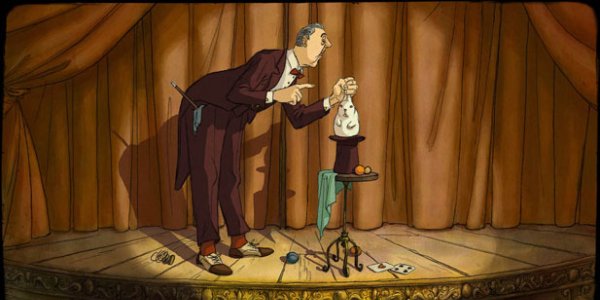
Review: The Illusionist (2010)

The Illusionist is a dazzling, magical love letter to Edinburg, directed by the marvellously talented Sylvain Chomet.

It tells the story of a French illusionist who, when he finds himself out of work, travels to Scotland, where he meets a young woman. Their ensuing adventure changes both their lives forever.

While the story may be basic, what we see on-screen offers more to the imagination than could ever be transcribed in words. Chomet. Each scene has been lovingly drawn to ultimate perfection to ensure an original story, by the talented French comic Jacques Tati, is brought to life in a dignified, beautiful way.

By doing this, Chomet is able to remind audiences of the attention to detail and amount of personality and love that comes with hand-drawn 2D animation.

Showcasing a picturesque Edinburgh in the mid 1950’s, The Illusionist is a comical, heartwarming and beautifly captured film that will enchant anyone.

The Illusionist is a beautifully real, stylistic and moving piece of cinema. An utter joy to behold.

Review: Let Me In (2010)

Matt Reeves’ Let Me In is the second film to be adapted from John Ajvide Lindqvist’s acclaimed horror novel Let The Right One In; the first being Thomas Alfredson’s skilfully directed companion piece of the same name.

Let Me In is Reeves’ difficult second film following his debut Cloverfield, 2008’s found-footage smash-hit, and sees him tackling altogether different themes.

The story, for those not already aware, deals with a bullied young boy, played by Kodi-Smit McPhee, who befriends a young female vampire, played by Chloe Moretz, who lives in secrecy with her guardian.

In many ways, Let Me In feels darker and explicit than Let The Right One In, perhaps as it’s aimed squarely at the American horror market. Reeves’ version, although almost identical to Alfredson’s, is more accessible.

This is not necessarily something that benefits the film as a whole, as he relies too heavily on expensive, yet cheap-looking special effects and over-bearing, Americanised dialogue, which in turns makes the entire film feel like the exact thing Reeves was hoping to avoid, an American knock-off of a truly excellent foreign language horror film.

However, when it works, it works very well indeed. The sequences between Owen and Abby are subtle, honest and afflicting. Some of the horror sequences towards the beginning of the film work well in creating tension and providing chills.

Chloe Moretz and Kodi-Smit McPhee as Owen and Abby respectively, provide two of the most disturbing, restrained, afflicting and daring performances of the year. There chemistry and underlying troubles are captured perfectly by Reeves’ direction and convincingly by the dialogue.

Michael Giacchino’s score is sombre, moody and a masterpiece in it’s own right. Against the film, it fails to achieve it’s set goal and maintain the tension throughout the film’s tedious running time.

Let Me In undoubtedly struggles to match up to the cinematic masterpiece Let The Right One In is, even failing to meet it’s own purpose. Reeves tries valiantly to craft a individualistic adaptation, one that reignites the Hammer horror genre, but ultimately creates a cheap-looking, sometimes effective, showcase for two bright stars.

Let Me in is still a stunning piece of cinema at the heart, with some truly excellent performances and unnerving horror sequences. However, none of that excuses the terrible, Americanised dialogue and over-used special effects. It felt far too meticulous at times, which is a shame, as it certainly possessed the potential to be quite magnificent.

Review: Another Year (2010)

Mike Leigh returns with a measured, powerful and wholly realistic human drama.

Another Year centres on Tom and Gerry (Jim Broadbent and Ruth Sheen), a blissfully happy married couple and their unconventional, unhappy friends and relatives.

Mary (Lesley Manville), Gerry’s wayward, lonely co-worker, reeks desperation, but hides it underneath her bubbly and free-spirited mask. Mary has a deep love for the life Tom and Gerry lead and wants nothing more than to have someone to simply confide in.

However, when her hidden-desire for their son Joe (Oliver Maltman) results in her mocking his new girlfriend Katie (Karina Fernandez), she is subtly rejected by the household, which leads to her ultimate breakdown.

Mike Leigh’s direction is flawless. Lingering shots may feel uncomfortable to viewers on the outside, but are commonplace in the lives of the characters on screen. By focusing on one single-day per calendar season, Another Year provides a wholly honest insight into the workings of a older couple and their lonely, single friends.

Taking a laid back and detached approach, Leigh let the film’s story and characters breathe, never infringing upon a scene or piece of dialogue. The lack of soundtrack went unnoticed, as it would have deterred from the emotional impact each scene had upon the viewer.

Lesley Manville is pitch-perfect as wayward Mary, making the character convincing, yet never over-the-top. Manville slipped into the character of Mary from the get-go, always pushing her characters desperation to the centre of the film, no matter how many sub plots came and went and never slipping into a caricature.

Jim Broadbent and Ruth Sheen complimented each other down to a tee, Gerry coming across as a down-to-earth family wife, with a stern, protective inside. Tom is witty, able to glaze over the depressing moments of life, which comes with both good and bad aspects.

The supporting cast each give convincing and afflicting performances and suitably complement the older actors. Even Imelda Staunton’s cameo role towards the start of the film as a troubled mother has an impact on the overall tone and nature of the film.

Another Year is an almost perfect slice of British cinema, digging behind-the-scenes of a quint-essential family in the heart of Britain and bringing to light their turbulent, drab and ultimately tragic lives. Tremendous.

Review: The Kids Are All Right (2010)

Lisa Cholodenko directs The Kids Are All Right, a mainstream comedy drama about modern family life.

The film centers on Jules (Julianne Moore) and Nic (Annette Bening), a strained lesbian couple living in the suburbs of California, who each gave birth to one of their children using a sperm donor.

When the eldest child, Joni (Mia Wasikowska) turns eighteen, her brother, Laser (Josh Hutcherson) asks her to initiate contact with their biological father, Paul (Mark Ruffalo), an attractive, single, laid-back restaurateur

Each of the family members respond to Paul in different ways: free-spirited Jules welcomes him with open arms; head of the family Nic grits her teeth; Joni hits it off with him straight away; while Laser almost rejects him and his self-centered attitude.

The partnership between Moore’s Jules and Benning’s Nic is pitch-perfect. Their personalities are vastly different, but appear to work well together. It’s only during the film as events reach a head that the true reality of their relationship is exposed. Both actresses handle the material beautifully, forming an understandable, and wholly believable, lesbian couple.

Ruffalo delivers one of his most under-stated, yet dignified performances, displaying a range of emotions through the body of an often immature and underdeveloped man. Paul breaks the equilibrium, forcing each character, in turn, to re-address their position within the family.

Mia Wasikowska and Josh Hutcherson as the children, Joni and Laser respectively, both provide clever and self-assured performances. Wasikowska in particular, in that tricky second film, shows she’s blossoming into a fine adolescent actress.

Cholodenko’s direction is superb, using the correct lighting and camera shots to add meaning and depth to each of her scenes and character profiles. Despite sometimes verging on static, she always manages to pull it back, the sign of a truly exceptional director.

The screenplay is well executed. Cholodenko and Stuart Blumberg are able to find the perfect balance between humour and afflicting, allowing viewers to empathise with each character, never influencing our interpretation. Cholodenko’s personal experience with sperm donation quite clearly had an influence on the film’s narrative, but the film evidently benefits from the personal touch, managing to avoid common clichés and melodrama.

By exploring an experimental model of family, Cholodenko bravely introduces viewers to subject matter not normally addressed within Hollywood films. While this may put off some people, it’s something those willing to accept should celebrate.

A subplot focusing on Laser’s friendship with wayward skater Clay feels unnecessary, and the kids’ parts often feel slightly less integral than that of the adult trio. However, these are minor pitfalls, and never detract from the overall enjoyment or meaning of the film.

In all honesty, The Kids Are All Right a fantastic film, exuding charm, wit, love, insecurity and anguish at every appropriate corner. In essence, it’s a film about the struggles of human relationships, and shows a family’s love has the potential to overcome any obstacle. It’s certainly one of the finer films of the year.

Cinema Releases: January 7, 2011

Season Of The Witch

Director – Dominic Sena

Starring – Nicolas Cage, Ron Perlman and Claire Foy

The King’s Speech

Director – Tom Hooper

Starring – Colin Firth, Helena Bonham Carter and Geoffrey Rush

It’s Kind Of A Funny Story

Director – Anna Boden and Ryan Fleck

Starring – Keir Gilchrist, Zach Galifianakis and Emma Roberts

Abel

Director – Diego Luna

Starring – Geraldine Alejandra, Karina Gidi and Christopher Ruíz-Esparza

Amer

Director – Hélène Cattet and Bruno Forzani

Starring – Cassandra Forêt, Charlotte Eugène Guibeaud and Marie Bos

Review: 127 Hours (2010)

Danny Boyle’s new movie, 127 Hours, sets the director’s frenetic nature and breathtaking use of visual storytelling against an honest, uplifting tale of survival.

127 Hours is based on the true story of the mountain climber Aron Ralston – played by James Franco – who takes a trip to Utah to explore the Blue John canyon.

Ralston parks his car and cycles 17 miles to the canyon, where he bumps into two female mountaineers (Amber Tamblyn and Kate Mara).

After some frivolous activities, Ralston separates from the women and continues to explore, until his arm becomes pinned beneath a falling boulder, trapping him at the bottom of the canyon with nothing more than a bottle of water and a blunt penknife.

The opening act plays furiously, with Boyle intercutting images of city life with the tremendous representation of the Blue John canyon, captured superbly by cinematographers Anthony Dod Mantle and Enrique Chediak.

Franco’s Ralston is introduced as a candid, brutally confident and determined young man who leaves life’s troubles behind to bask in the freedom of the barren outback; a sentiment which enables the audience to empathise with the character from the offset.

The main focus of the film, however, is on Ralston’s initially rational, but increasingly delusional thoughts over the course of the 127 hours he’s stuck at the bottom of the canyon.

Boyle’s intense and crowded use of mise-en-scene, together with the repeated flashbacks and dream sequences, work extremely well in highlighting Ralston’s increasingly damaged mental state, something that’s further stressed by A. R. Rahman’s complimentary score.

The amputation scene, although graphic and matter-of-factly horrific, is smartly done. Boyle, while never hiding anything from the audience, never lingers too long, instead opting to focus on the sheer determination Ralston has to escape certain death and return to his loved ones.

Franco carries the film with an immensely sympathetic, yet restrained performance, one that, to his merit, never slips into the melodramatic and should earn him a well-deserved Academy Award nomination.

127 Hours is, at times, an excruciatingly difficult film to watch. Nevertheless, it is a masterfully vivid, tense, yet oddly exhilarating and uplifting film about one man’s determination and struggle for survival.

Credit must be given to Boyle, who turns a virtually unwatchable premise into an engaging, powerfully honest film to be savoured by the masses.

Cinema Releases: January 5, 2011

127 Hours

Director – Danny Boyle

Starring – James Franco, Amber Heard and Kate Mara

The Next Three Days

Director – Paul Haggis

Starring – Russell Crowe, Elizabeth Banks and Liam Neeson