Review: Welcome To The Rileys (2010)

Welcome To The Rileys is a promising debut feature from music video director Jake Scott about tossed souls learning to overcome sorrow and loss.

The film follows Doug Riley (James Gandolfini), a damaged plumbing-supply salesman who struggles to find his place in the world after the death of his daughter, Emily. Things start to look up for Doug when he goes to New Orleans for a conference and meets an underage stripper named Mallory (Kristen Stewart). When Doug tells his wife, Lois (Melissa Leo), he’s not coming home, her response triggers a change for all three characters.

Essentially the film is made up of two parts: the first is the odd, father-daughter relationship between Doug and Malorey; and the second centers on Lois as she is forced to overcome her agoraphobia to save her marriage. When the two worlds are brought together, there’s an initial reluctance from all side, beautifully played by each actor, before they slowly begin to accept each others flaws and mould together.

The narrative is driven by the quieter, intimate moments shared between the characters, rather than relying on brash, noisy confrontations to propel events forward. This technique makes the film more realistic and raw, allowing audiences to understand the characters’ pain and disparity, but also, mainly towards the end, makes the film feel too bitter-sweet, like it’s trying to hard to wrap things up in a neat, content bow.

Gandolfini plays Doug as a benevolent, caring father-figure to Malorey and honest, earnest husband to Lois. Leo is exceptional as the troubled, lost soul Lois, who is pushed to reclaim her life and sense of being through events out of her reach. Stewart brings a naked vulnerability to her performances as Malorey, crafting her into a realistic and vibrant character, haunted by her loneliness and troubled upbringing.

Welcome To The Rileys is a solid debut piece of filmmaking from Jake Scott, driven by its honest script and three brave and charismatic performances.
Review: Blue Valentine (2010)

Derek Cianfrance directs Blue Valentine, an exacting, achingly distressing look at the complexity of a marriage and its steady dissolve.

The narrative unfolds in a non-linear fashion over two timelines as it tracks the burgeoning romance between Dean (Gosling) and Cindy (Williams), and its eventual breakdown.

The action flicks back and forth, transposing the bright optimism of their young romance – each yearning for one another’s veracity – against the buried anguish and turmoil the dissolve has lead to.

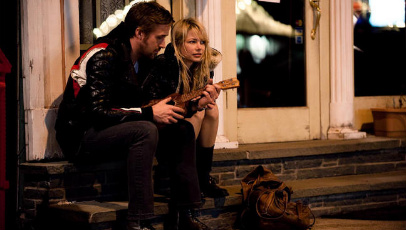
Gosling’s Dean, through flashbacks, is seen as a charming, caring guy, while Williams’ Cindy is an intelligent, wholesome girl attracted to Dean’s fun-loving nature – beautifully captured in a scene where Dean’s playing a ukulele as Cindy dances along.

Their personalities age with the turbulent marriage, Gosling undercuts his characters’ charm with a frightening anger and eruptiveness. Williams’ contained performance as the older Cindy exudes despair and hopelessness, surmising her feelings towards her changed husband.

Cianfrance beautifully transposes the two different time periods with pitch-perfect direction. He uses penetrating camera angles and subdued lighting to represent the turmoil the relationship has become, while intercutting this with bright, snappy flashbacks to convey the puppy-love beginnings.

The film is a deeply visceral experience, pulling you from one emotion to another as it skips so dramatically from the giddy hopes of young love to the painful sorrow of this union’s death throes.

Grizzly Bear’s stripped back tracks are used to great avail as the films core soundtrack, further adding to the emotional integrity this film boasts.

Equally, in the scene where Dean sing’s “You Always Hurt the Ones You Love” and Cindy dances along, the emotional devastation set to behold the troubled pair is hinted as subtly, yet devastatingly so.

Blue Valentine is an emotionally affecting, raw and impeccably acted portrait of a doomed marriage, making brilliant use of the complex, non-linear narrative structure, gaining complete control over the audiences emotions from start to finish.

A breathtakingly real piece of filmmaking from a talented up-and-coming director.

UK Box Office: January 7 – 9, 2011

1. The King’s Speech – £3,523,102

2. 127 Hours – £2,168,570

3. Little Fockers – £1,798,677

4. Gulliver’s Travels – £1,554,266

5. The Next Three Days – £1,046,333

6. Love & Other Drugs – £807,912

7. Harry Potter And The Deathly Hallows: Part One – £712,728

8. Tron: Legacy – £639,903

9. The Chronicles Of Narnia: The Voyage Of The Dawn Treader – £621,393

10. Season Of The Witch – £559,769

Review: Half Nelson (2006)

Directed by writer-director team Anna Boden and Ryan Fleck, Half Nelson centers on an inter-city high school teacher (Gosling) with a drug habit who forms an unlikely bond with one of his students (Epps).

Boden and Fleck’s direction is impressive, managing to capture the action in an unsentimental and raw manner that’s brimming with humanity and emotional depth.

The relationship between Dan and Drey is pushed to the forefront as both find common-ground with each other through the problems they harbor as they battle to reach their own personal resolutions.

Through the awkward and bleak tone of the film humour erupts naturally, breaking the tension and enabling the audience to emote with and relate to the characters’ problems and hard-hitting themes of addiction, loneliness and acceptance that are explored through the films hard-hitting premise.

Gosling gives a stunning and mesmerising performance as the drug addict teacher, distinguishing this film from others of its nature and warranting his much-deserved Academy Award nomination.

Half Nelson is a well-balanced, brilliantly acted and refreshingly humorous study into the rarity of second chances.

DVD Releases: January 10, 2011

The Girl Who Played With Fire

Director – Daniel Alfredson

Starring – Noomi Rapace, Michael Nyqvist and Lena Endre

Resident Evil: Afterlife

Director – Paul W. S. Anderson

Starring – Milla Jovovich, Ali Larter and Wentworth Miller

Catfish

Director – Henry Joost and Ariel Schulman

Starring – Megan Faccio, Melody C. Roscher and Ariel Schulman

Gainsbourg

Director – Joann Sfar

Starring – Eric Elmosnino, Lucy Gordon and Laetitia Casta

I’m Still Here

Director – Casey Affleck

Starring – Joaquin Phoenix, Casey Affleck and Sean ‘P. Diddy’ Combs

Please Give

Director – Nicole Holofcener

Starring – Rebecca Hall, Catherine Keener and Oliver Platt

F

Director – Johannes Roberts

Starring – David Schofield, Eliza Bennett and Ruth Gemmell

Brilliantlove

Director – Ashley Horner

Starring – Arabella Arnott, Stephen Bent and Liam Browne

Baaria

Director – Giuseppe Tornatore

Starring – Francesco Scianna, Margareth Madè and Raoul Bova

US Box Office: January 7 – 9, 2011

1. True Grit – $15,000,000

2. Little Fockers – $13,781,000

3. Season Of The Witch – $10,726,000

4. Tron: Legacy – $9,803,000

5. Black Swan – $8,350,000

6. Country Strong – $7,300,000

7. The Fighter – $7,000,000

8. The King’s Speech – $6,811,000

9. Yogi Bear – $6,810,000

10. Tangled – $5,200,000

Review: It’s Kind Of A Funny Story (2010)

Based on a teen novel by author Ned Vizzini, It’s Kind Of A Funny Story is a new comedy-drama from the hotly-tipped writer-director team Anna Boden and Ryan Fleck (Half Nelson).

The film centers on a clinically depressed teenager, Craig (Keir Gilchrist), who gets a new start when he checks himself into an adult psychiatric ward after contemplating suicide.

It’s Kind Of A Funny story marks the first time Boden and Fleck have not worked from their own material and the lack of character development and authenticity of the plot is noticeable from the offset.

It’s a light comedy that, although managing to avoid common cliches of the genre, ultimately feels too simplistic, cherry-topping the severity of mental health issues, making them somewhat feel implausible and negligible.

A common trait of this is whenever characters’ health issues are touched upon the direction of the film suddenly switches, as if the writers are sidestepping the underlying complexity of the films premise, instead focusing on the unconvincing relationships between the central characters.

Boden and Fleck can’t be blamed for the writing, but their handling of the material often feels dull and laborious, something that makes the film ultimately monotonous a waste to its audience. It almost seems as though they’ve regressed after the sublime, authentic Half Nelson.

The cast, on the other hand – lead by Gilchrist, Emma Roberts and Zach Galifianakis – boast likeable, dynamic and intermittently convincing performances with the material they have. It’s just a shame they’re let down by an incoherent script, detached direction and inconceivably unbelievable character relations.

It’s Kind Of A Funny Story is an agonisingly bland, contradictory and unoriginal film. The only glimmer of hope for Boden and Fleck’s future comes from the respectable performances and Broken Social Scene’s breezy, equivocal soundtrack.

Review: Winter’s Bone (2010)

Winter’s Bone is a vivid adaptation Daniel Woodrell’s crime novel set in the heart of the Ozark Mountains, Missouri.

17 year-old Ree Dolly (Jennifer Lawrence) is responsible for keeping her family together in a dirt poor rural area. When the local Sheriff (Garret Dillahunt) tells her that her father put up their house as collateral for his bail, Ree sets off to find her errant father, digging up some very dangerous secrets in the process.

Debra Granik brings this bleak environment to life through her flawless attention-to-detail, her keen eye capturing the landscape’s undertones beautifully. Granik tells the story as naturalistic drama, punctuating thrills throughout to keep them authentic and unexpected.

The most obvious example of this is through the character of Teardrop, Ree’s uncle, whom she asks for help. John Hawkes’ performance as Teardrop is haunting, verging on sadistic as it’s never made clear to Ree, or to the audience, whether he will help Ree, assault her, or kill her.

Lawrence’s performance as Ree is a truly stand-out piece of acting, transposing her apparent emotional intelligence and warmth with the incredible pressure she’s under to keep her family alive.

Winter’s Bone is a realistic, engaging and fearless film about transgression and the consequences of digging into the past, showcasing a truly magnificent, afflicting performance from Jennifer Lawrence.

Review: The Runaways (2010)

The Runaways, although heavily advertised around Kristen Stewart’s uncanny resemblance to Joan Jett, centres upon Dakoka Fanning’s turn as Cherie Currie and her sudden rise to fame in the first all-female rock group, The Runaways.

Fanning, now a 16-year-old, embodies the reckless character with sheer determination and passion, distancing herself greatly from her childhood roles in such films as Charlotte’s Web and The Cat In The Hat, whilst cementing her transition from childhood sweetheart to a grown-up, serious actress.

Stewart, with her almost uncanny resemblance to her character, takes on the role of Joan Jett, proving to audiences and critics alike that there’s a lot more to her than weak, moody character of Bella from the Twilight films.

In terms of supporting cast, it has to be noted that Michael Shannon fits the role of Fowley perfectly, verging on the brink of total insanity, while Stella Maeve, Scout Taylor-Compton and Riley Keough all give strong performances as the other members of the band.

Floria Sigismondi displays true potential with her particular style of cinematography and attention-to-detail, framing the action beautifully, illustrating the growth both lead characters experience with a sense of ambiguity, which helps keep the film light-weight, and it’s all the best for it.

The Runaways may not be one of the best biopics ever made, but it gives a fun, electric and gritty glimpse into the lives of a group of five teenagers being rocketed to fame in the first female punk band.

Review: Toy Story 3 (2010)

After 10 critically and commercially successful animated films, Pixar have established themselves as one of the foremost animation studios in the world, only to be rivalled by the likes of Studio Ghibli and Dreamworks Animation. Not only do Pixar distribute world-renowned films, but they’re also able to find the perfect mix of adult and child humour to entertain all demographics, something which some live-action films fail to achieve.

Toy Story 3’s release comes 11 years after Toy Story 2 hit cinema screens back in 1999, and finds Andy, now 17-years-old, departing for college, with his toys finding themsevles shipped off to a daycare centre known as Sunnyside. Old favourites Woody, Buzz, et al return for the final film, with new character in the form of the play-things found at the Sunnyside daycare centre, headed up by Lots-o’-Huggin’-Bear. The new toys are a perfect addition to an already wondrous line-up of toys. How Pixar keep coming up with new and inventive ideas is beyond me, but they never fail to capture, as well as dazzle, audiences around the world with their imaginative creations.

Sunnyside, despite the utopian facade, isn’t the safe haven the toys had hoped for, and it’s up to Woody to devise a cunning plan to help them escape and return to Andy before he departs for college. What ensues it a perfect quick-beat escape montage, mad-cap action sequences and hilarious setups, one in particular featuring Mr Potato Head.

Despite the heavy marketing surrounding the new Ken toy, with Michael Keaton providing excellent comic-timing, stealing the film, all characters are given ample screen-time, with a send-off that will have you wishing you’d brought tissues. It’s another example of how cutting-edge Pixar is as an animation studio, pushing the boundaries of the genre, whilst making their films funny and appealing to people of all demographics. It’s especially important with Toy Story 3, which comes 15 years after these incredible characters were first introduced to audiences. That audience, as well as the film, have moved on, so it’s wonderful to be able to see that change and growth reflected in the films tone, plot, attention-to-detail and character relations.

I was a little worried when I first read they were going to make Toy Story 3, mainly because I wasn’t entirely sure if they’d be able to match the success of the first two but, it’s with wondrous delight to say it’s honestly everything I hoped for, and more. From the ingenious opening sequences, to the final send-off, Toy Story 3 is a fitting, touching, funny and honest way to end one of the most beloved, and inspiring, franchises of all time. To this day, with 11 feature films in the bag, I marvel at everything Pixar has ever produced. Even the short, Night & Day, shown before before the feature film, displays how far animation has come in the past 15 years, and takes a nod at both 2D, the technology of the past, as well as 3D, the technology that will push directors to achieve greater things in the days and years to come. Pixar, I salute you.

Toy Story 3 was everything I wanted, and more. Funny, touching and assuring; the perfect ending to a marvellous trilogy.