Review: Piranha 3D (2010)

Piranha 3D is a remake of a Joe Dante film originally released in 1978. A rip-off of Jaws, but one that surpassed it’s source material in many respects, it was brilliant piece of B-movie fodder, managing to be tense and gory, while providing a tongue-in-cheek take on the horror genre.

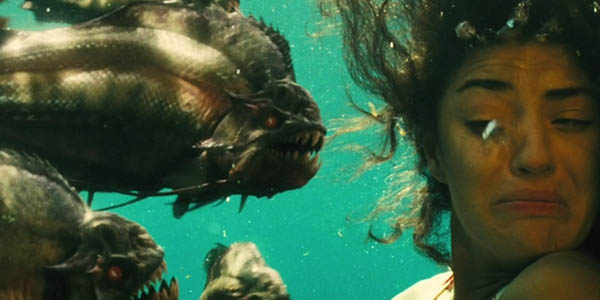
Piranha 3D takes what Joe Dante created and brings it into the 21st century. This time, the setting is Lake Victoria, a desolate place struck by an earthquake, causing a rift in the central lake to open, unleashes thousands upon thousands of ravenous prehistoric piranha’s. Meanwhile, elsewhere on the shores of Lake Victoria, spring break is in full swing, with thousands of college students enjoying sun, sea and sex.

Alexandre Aja, directing from a script penned by Pete Goldfinger and Josh Stolberg, using techniques learnt from Mirrors, The Hills Have Eyes and Switchblade Romance, executes a perfectly gory, tongue-in-cheek B-movie filled with gratuitous nudity and hammy acting. The death scenes are hugely melodramatic, with shed loads of blood, severed limbs and one particularly disturbing scene where Jerry O’Connell’s filmmaker character has his penis eaten by a piranha.

The DVD does offer you the chance to watch it in both 2D and 3D, but to fully appreciate the gore and magnificently inventive death scenes, it’s a film that needs to be experienced in that extra dimension.

The cast play their parts in a terribly humorous and captivating way. Richard Dreyfuss and Christopher Lloyd provide memorable cameo appearances, while Elisabeth Shue, Jerry O’Connell, Steven R. McQueen and Jessica Szohr make for a weirdly intriguing main cast, each bringing vigour and unique personalities to their respective on-screen characters.

Granted, some people will find it vile, disturbing and unnecessary, but if you look at it as it’s intended to be seen, as a shlock horror film, then it’s very well done. While the 3D doesn’t add anything per se, it does provide an extra dimension to the on-screen torment, ramping up the horror factor to whole a other level.

Piranha 3D is a thoroughly entertaining and profoundly gory horror creature feature. Near-perfect, guilty pleasure schlock. It is pretty much everything Snakes on a Plane wanted to be, and a little more.

Review: Scott Pilgrim Vs. The World (2010)

Edgar Wright’s Scott Pilgrim Vs. The World is a story of a 22-year-old bassist, Scott Pilgrim (Michael Cera), who plays in a band called Sex Bob-Omb and dates a high school girl (Ellen Wong). Everything changes when he happens upon Ramona Flowers (Mary Elizabeth Winstead) who infects his brain, which eventually becomes an obsession of his.

Not is all well, though, as Ramona comes with some heavy baggage. The baggage just so happens to be in the form of seven evil exes, all of which have super powers. Scott must defeat each evil ex in order to take his love affair with Ramona to the next level. The evil exes themselves (portrayed by Chris Evans, Brandon Routh, Jason Swartzman, Mae Whitman, Keita and Shoto Saito and Satya Bhabha), despite their brief on-screen presence, are a welcome addition to the film, while never detracting from the films overall purpose.

The partnership between Cera’s Scott and Winstead’s Ramona is pitch-perfect. Combing her effortless, beyond cliché nature, with his haphazard, anxious being may sound like a recipe for disaster, but the pair make it work, en-capturing audiences attention, making us care about their relationship.

Another reason Scott Pilgrim Vs. The World works so well is due to the supporting cast. Not only do Cera and Elizabeth provide a likeable, and explorable love affair, but co-stars such as Kieran Culkin, Alison Pill, Aubrey Plaza and Johnny Simmons all shine in their respective parts, delivering laugh-out-loud one-liners and welcome sub-plots to the main story-arc. Ellen Wong and Anna Kendrick in particular administer stand-out performances, showcasing their incredibly diverse talent.

Wright’s direction is superb, managing to make the film visually spectacular and inventive, whilst maintaining an old-fashioned, youthful nature. Fusing live-action with video-game and comic-book intellect was always going to be a risk, but Scott Pilgrim Vs. The World pulls it off perfectly.

The films screenplay, an adaptation of Bryan O’Malley’s comic-book series, has so many levels, that there’s sure to be something on offer for everyone. On the surface, Scott Pilgrim Vs. The World is all about the zany action sequences, awkward teenage humour and video-game references. Underneath, however, there’s a whole new level of meaning, one that explores the true meaning of love and how relationships are never easy, but full of obstacles couples must overcome to reach their destiny.

While the awkward subject matter and unfortunately poorly-executed marketing campaign ended up hurting the box office gross, the film will undoubtedly find a home on DVD amongst young, or the young-at heart who like zany indie films that explore deep, poignant ideas, inter-cut by lots of crazy, heart-pounding, fighting scenes and witty dialogue.

Seek it out. Scott Pilgrim Vs. The World is a film that deserves an appreciative audience.

Review: Monsters (2010)

Gareth Edwards’ low-budget debut Monsters is a genre-blurring tour de force that feels like a road movie, with added elements of romance and science fiction.

Monsters centers on a US journalist (Scoot McNairy) who agrees to escort a shaken tourist (Whitney Able) through an alien-infected zone in Mexico to the supposed safety of the US border.

McNairy and Able, both relative newcomers, provide powerful, realistic and nuanced performances as an unlikely duo thrust together in a bid for survival.

The relationship between Scoot’s While and Able’s Sam feels candid, enchanting; their bubbling chemistry undeniably up front, something that makes the film feel a lot more naturalistic and credible than other, more glamourised alien invasion films.

The special effects, while implemented with a meagre budget, never feel cheap, perhaps as they are second place to the humane story at the forefront, one that’s able to remain authentic throughout.

Edwards’ direction is flawless, creating a beautiful, yet hauntingly frightening, indie film that should antagonise other guerrilla filmmakers of his league.

Monsters is an incredible achievement in more ways than one, showcasing fine performances, an afflicting narrative, wholly real character interactions and special effects that rival those used on Blockbusters.

Review: The Way Back (2010)

Peter Weir’s latest is a long-gestating film adaptation of Slavomir Rawicz’s The Long Walk: The True Story Of A Trek To Freedom.

The film centres a Polish lieutenant (Jim Sturgess) tortured by the Russian secret police and sent to a Siberian gulag on trumped-up charges who, along with several other falsely incarcerated men, travels 4,000 by foot to freedom.

Weir’s adaptation is a captivating film, using a tale of survival to explore deep, meaningful themes of existence and morality.

The cinematic vision compliments these moral explorations, the rough terrain symbolising the harshness of human existence and the trials we must face throughout our lives.

Sturgess proves his worth as the Polish leader, while Ed Harris and Colin Farrell each provide canny turns as criminals seeking redemption and worthwhile meaning.

Saoirse Ronan, in a walk-on part as 14-year-old Polish girl , who brings out the compassionate side of each character before succumbing to the torturous landscapes.

The main downfall is the distance kept between viewer and character. We are kept at arms length throughout the film, preventing one from becoming entirely engaged and emotionally involved with the hardship unravelling on screen.

The Way Back is a riveting and visually beautiful film that makes you question your own morality, but it’s overly long running time and poor character development results in it failing to achieve it’s full potential.

Review: Gulliver’s Travels (2010)

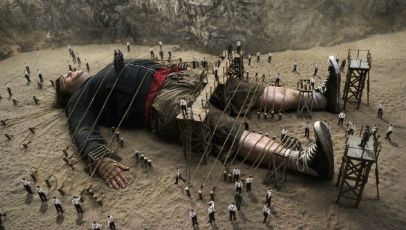
Gulliver’s Travels is, quite simply, an abomination to cinema.

Avoid.

Review: Somewhere (2010)

After the candid and poorly-recieved Marie Antoinette, Sofia Coppola returns to familiar ground with her fourth feature Somewhere, a low-key and heartfelt exploration of love and atonement.

The film is a portrait of Hollywood actor Johnny Marco (Stephen Dorff), who has settled into a life filled with booze, pole dancers, sex and reliance on prescription drugs.

When his daughter, Cleo (Fanning), is thrust into his protection, he’s forced to re-examine his life and find a way to take care of his daughter.

Almost the entire film is set at the famous Chateau Marmont in California. A character in itself, the hotel can be interpreted as a type of purgatory. Johnny’s desires are so easily gratified that he’s left with no inclination or need to leave it’s confinements. It’s almost a metaphor of his own uncertain place in life.

Stephen Dorff delivers a nuanced, troubled performance as off-the-rails Johnny, something that is exemplified in the scenes with Fanning’s Cleo.

Futhermore, Fanning is wonderful as the devoted and fragile daughter, providing a wholly astute and bewitching performance that compliments Dorff’s absolutely.

The immediate lack of on screen tension and any real progression towards an absolute end in the narrative may unfortunately dispel some movie-goers but, then again, Sofia Coppola’s style has never been for everyone.

For those, however, who do admire Sofia Coppola’s attention-to-detail – highlighted perfectly by Harris Savides’ mesmerising cinematography – Somewhere is a powerful, well-directed piece that, despite it’s slow-burning pace and lack of finite conclusion, deserves attention.

Review: Burlesque (2010)

Burlesque is a predictable and cliched musical drama from writer-director Steven Antin.

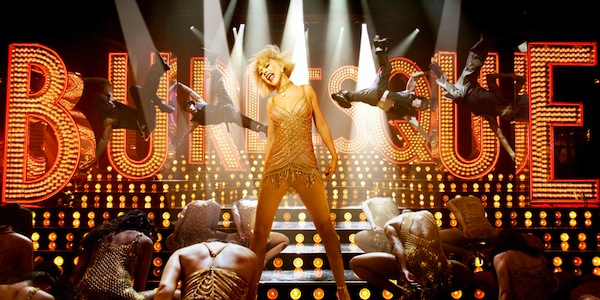
The film centres on Ali (Christina Aguilera), a small-town girl who moves to L.A. and finds her place singing and dancing in a burlesque club run by a former dancer, Tess (Cher).

Antin’s script is utterly brain dead from the offset, devoid of any life or real character development and too heavy on inane cliches and much-too-obvious stereotypes. The dialogue is as insipid as the actors fumbling to deliver them.

On the subject of acting, Aguilera, in her first feature-film appearance, is forgettable as the wannabe Ali, while supporting actors in the form of Stanley Tucci, Cam Gigandet and Kristen Bell are left underdeveloped, despite their attempts at injecting some much-needed life and humour into the deplorable attempts at drama.

The strength of the film, therein, lies in the musical and dance numbers. If nothing else, it proves Aguilera has a powerful set of lungs, and even allows Cher the chance to make a low-key comeback with a pair of performances that, surprisingly, evoke the most emotion out of the whole production.

All in all, if it’s mindless entertainment, music and show-stopping dance numbers you’re after, then Burlesque may just be for you. If, however, you’re looking for an engaging narrative and characters you can emote with, try elsewhere.

Review: The King’s Speech (2010)

Tom Hooper returns to the period drama genre with The King’s Speech, a subtly told tale of life-long struggles and friendship, set during the build-up to World War II.

The King’s Speech tells the story of King George VI (Colin Firth) who, after his brother abdicates the throne, reluctantly becomes king. Plagued by a stammer, George and his wife Elizabeth (Helena Bonham Carter) enlist the help of unorthodox speech therapist Lionel Logue (Geoffrey Rush).

From here, as the characters battle through countless speech sessions, comic fights and heartfelt exchanges, the film builds to a excellent, adrenaline-pumping crescendo, George VI’s first war-time speech.

Firth’s performance as King George VI is remarkable. Not only is he able to portray the character with conviction and believability, but he acquires the stammer as though he’s been plagued with it himself his whole life.

Rush and Carter bring comedy to the film, lifting the tone from morbid period drama to a rousing, and uplifting tale, each holding their own opposite the masterful Firth.

Each of the three actors here should be guaranteed plenty of award nominations, in particular Firth, who has again proved himself as one of Britain’s finest actors.

In addition to the three central leads, there is strong support from Timothy Spall as Winston Churchill, Michael Gambon as King George V and Guy Pearce as King Edward VIII.

Hooper handles the material with care and style, producing a clever, humorous and emotional film that will have leave you lost for words.

A must see, by all accounts.